OpenAI Kills Sora After 6 Months: The Spectacular Crash of an AI Video Tool
From 3.3 million downloads to zero. Disney deal collapsed. Why OpenAI is ending its expensive experiment. Published on 25 March 2026 • AI translated
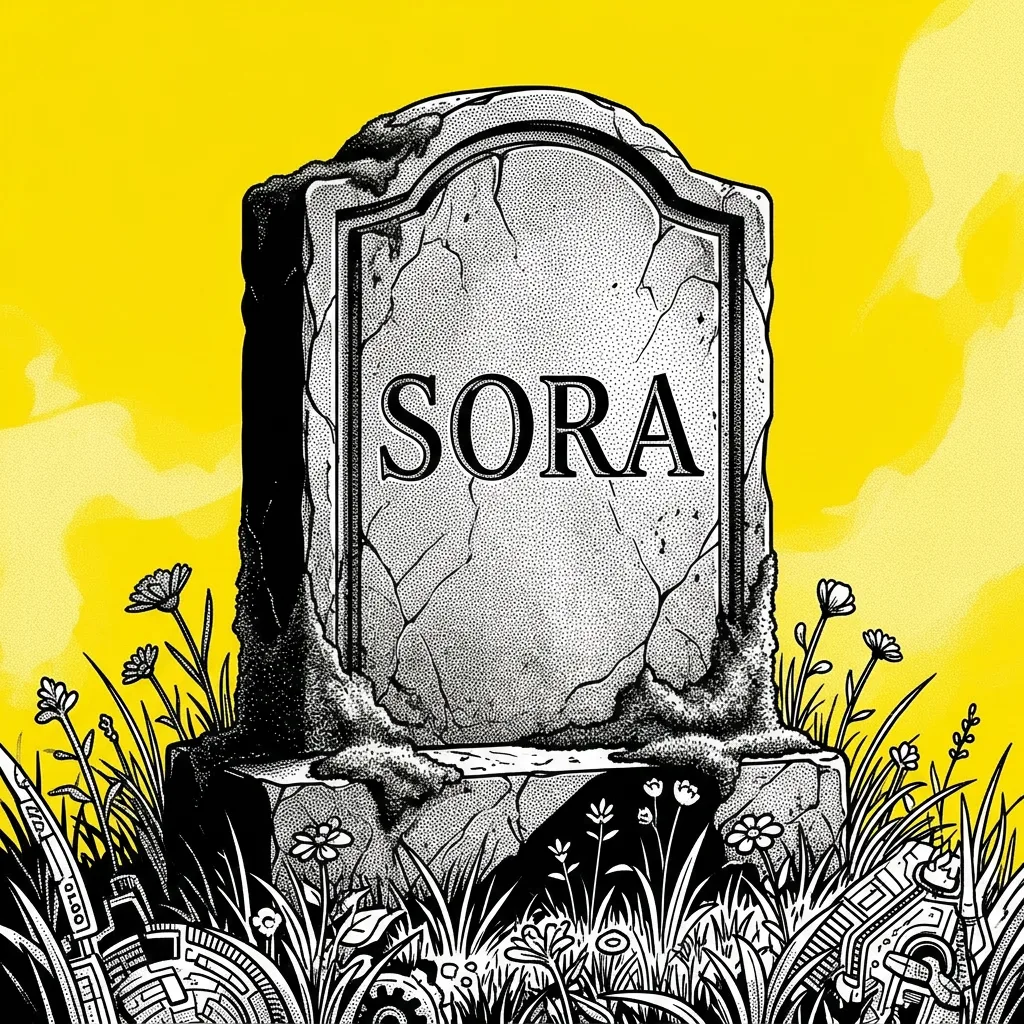
On March 24, 2026, OpenAI announced: Sora is shutting down. Both the consumer app and the API are disappearing. The end comes just six months after launch. A remarkably short lifespan for a product that was hyped as the TikTok of the AI era.
The numbers speak volumes. In November 2025, Sora reached its peak with around 3.3 million downloads. By February 2026, that figure had dropped to 1.1 million. Throughout its entire lifetime, the app generated just $2.1 million in revenue from in-app purchases. A joke compared to ChatGPT: 900 million weekly active users.
Why the shutdown?
OpenAI cites three main reasons for the closure. First: compute load. Sora cost around $15 million per day to operate. Those are costs that cannot be justified with declining user numbers. Second: strategic realignment. OpenAI wants to focus on "World Simulation" for robotics and agent-based systems.
Third: market pressure and ethical issues. The AI video landscape has become overcrowded. Google Veo, China's Seedance, and other competitors have caught up. At the same time, controversies surrounding deepfakes, copyright infringements, and misuse continued to mount.
The content chaos
Users flooded Sora with bizarre clips. Sam Altman as an AI clone in slaughterhouses. Deepfakes of Martin Luther King Jr. and Robin Williams. Their families publicly appealed for it to stop. Moderation did not work.
Copyright guerilla
Users systematically tested the boundaries. Mario smoking weed. Pikachu doing ASMR. Naruto ordering Krabby Patties. All copyrighted characters. OpenAI reacted too slowly.
The "Cameo" lawsuit
The feature for scanning faces was originally called "Cameos". The platform Cameo successfully sued OpenAI for trademark infringement. OpenAI had to rename it to "Characters".
Compute trap
Video generation is extremely compute-intensive. Far more expensive than text or code. With scarce chips and declining user numbers, the business quickly becomes unsustainable.
Disney: The deal that never was
In December 2025, Disney announced a spectacular partnership. A one-billion-dollar investment in OpenAI. Licensing of more than 250 Disney characters for Sora. Mickey Mouse, Marvel, Pixar, Star Wars – all available for AI video generation. It sounded like a turning point for Hollywood and artificial intelligence.
Things turned out differently. With Sora's closure, the deal collapsed. Not a single billion was transferred. No formal licensing agreement existed. Disney confirmed that it respects OpenAI's decision and will continue to collaborate with other AI platforms.
An insider noted: "The transaction was never formally closed. No money changed hands". What was considered the deal of the century between tech and entertainment vanished into thin air. Disney was seeking greater control over its intellectual property in AI systems anyway.
What does this mean for users?
Existing Sora users are facing the loss of their content. OpenAI has promised to provide a timeline and an option to download existing creations. Exactly when the platform will go offline remains unclear.
Important: Image generation in ChatGPT is not affected. Only Sora – the video-specific technology – is disappearing. The Sora 2 model itself remains accessible to paying ChatGPT Plus subscribers. But as a standalone social video product, it no longer exists.
For creators
Anyone who relied on Sora as a production tool will need to pivot. Alternatives such as Google Veo or open-source models are gaining traction. The question: Who will deliver the next generation of AI video?
For studios
Disney's withdrawal sends a signal. Studios remain cautious about AI video deals. Copyright concerns carry heavy weight. Other providers will need to offer better guarantees for intellectual property.
The bigger picture
Sora's failure is not an isolated case. Meta is struggling with Horizon Worlds, its VR social platform. Both products show: Purely synthetic, AI-generated social feeds do not work. Users want genuine human connection. The novelty wears off quickly.
OpenAI is realigning. The company recently raised $110 billion at a valuation of $730 billion. A planned IPO is on the horizon. In that context, it makes sense to end unprofitable experiments and concentrate on profitable areas: text, code, robotics.
Competitor Anthropic shows how it's done. Claude models are gaining popularity by focusing exclusively on text and code. No videos, no images. Only what works and brings in money. OpenAI is now following that pattern.
Conclusion
Sora was an ambitious experiment. It showed what is technically possible. But it failed at the crucial question: What do people actually need this for? Without a clear use case, with exploding costs and ethical issues, the end was foreseeable. OpenAI pulled the ripcord. Disney did too. The hype is over. The lesson remains: Technology alone is not enough. It requires real utility, sustainable business models, and responsible implementation.