GPT-5.3 Codex: OpenAI's new coding model is faster, smarter, more autonomous
On February 5, 2026, OpenAI released its most capable "agentic" coding model to date. It can not only write code, but also autonomously execute entire projects. Published on 6 February 2026 • AI translated
GPT-5.3 Codex is more than an update. It is a tool that has evolved from pure code generation into a digital team member. OpenAI describes it as the "most capable agentic coding model to date".
What does that mean in practice? The model can autonomously work on complex tasks over hours or days without losing context. At the same time, it can research, debug, document, and write tests.
Key Features at a Glance
25% Faster
GPT-5.3 Codex processes tasks roughly 25% faster than its predecessor, GPT-5.2-Codex. This saves time and costs.
Interactive Steering
You can steer the model in real time while it works. Ask questions, give feedback, change direction—all without losing context.
Fewer Tokens
The model requires about 50% fewer tokens for the same task. That means: cheaper to operate.
High Cybersecurity Capability
The first Codex model rated by OpenAI as having "High capability" for cybersecurity. It can identify vulnerabilities and develop defensive tools.
A notable detail: The model helped in its own development. OpenAI engineers used early versions of GPT-5.3 Codex to debug training and scale deployment infrastructure.
Benchmarks: Where Does GPT-5.3 Codex Stand?
.png)
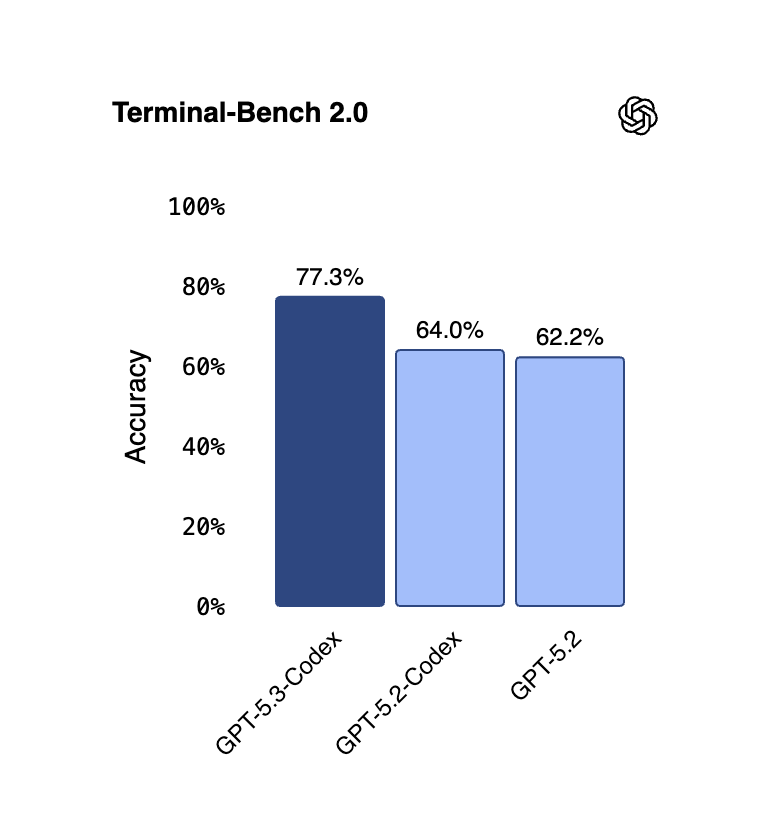
OpenAI provides numbers. Across three major benchmarks, the model shows solid improvements:
| Benchmark | GPT-5.3-Codex | GPT-5.2-Codex |
| SWE-Bench Pro | 56.8% | 56.4% |
| Terminal-Bench 2.0 | 77.3% | 64.0% |
| OSWorld-Verified | 64.7% | 38.2% |
Particularly striking: the massive leap on Terminal-Bench 2.0 (command-line capabilities) and OSWorld-Verified (general computer tasks). This demonstrates that the model can do more than just write code. It can operate a computer like a human.
However, the competition isn't sleeping. Anthropic's Claude Opus 4.6 achieves 72.7% on OSWorld-Verified. On Terminal-Bench 2.0, GPT-5.3 Codex takes the lead. Overall: no clear winner across all benchmarks.
Availability and Pricing
GPT-5.3 Codex is available immediately to all paid ChatGPT users. This includes:
ChatGPT Plus
$20 per month. Access via Codex App, CLI, IDE extensions, and web.
ChatGPT Pro
$200 per month. Higher usage limits and priority processing.
ChatGPT Business
$30 per user/month. Enterprise features, admin controls, no data used for training.
However: API access is still missing. OpenAI says it is coming "soon". For companies wanting to integrate the model into their own products, this is an issue. Without an API, there is no scaling.
Official API pricing is also pending. For comparison: GPT-5.2-Codex currently costs $1.75 per million input tokens and $14.00 per million output tokens.
Who Is GPT-5.3 Codex Relevant For?
The model is primarily aimed at developers and technical teams. It can handle:
Software Engineering
From planning to release. Refactoring, code reviews, legacy code modernization.
Cybersecurity
Automated vulnerability scans, threat pattern discovery, red-team simulations.
Documentation
Technical docs, API documentation, user manuals, compliance reports.
Business Workflows
Data analysis, reports, slide decks. Integrating code output with business metrics.
Important to understand: GPT-5.3 Codex is a foundation model, not an out-of-the-box business solution. Applying it to specific use cases requires engineering effort.
Conclusion: A Step Toward Autonomous AI Agents
GPT-5.3 Codex points to where things are heading. AI models are turning into autonomous agents capable of handling complex workflows. The line between "tool" and "teammate" is blurring.
For developers, this is a solid upgrade: faster, more efficient, more autonomous. But without API access, it remains a standalone tool for now. For companies, that means waiting—or relying on platforms that already offer ready-to-integrate solutions today.