Kimi K2.5: When AI Agents Think in a Swarm
Moonshot AI releases the first model that understands images, writes code, and coordinates 100 sub-agents. No bullshit. Published on 28 January 2026 • AI translated
With Kimi K2.5, Moonshot AI didn't just build an update. They changed the game. The model is based on Kimi K2, a mixture-of-experts system with 1 trillion parameters (32 billion active). On top of that, they trained 15 trillion mixed visual and text tokens.
The result? A model that turns screenshots into functional code. That reads scientific charts like a human. And that orchestrates 100 sub-agents simultaneously without a human having to define every step.
Agent Swarm: The Division of Labor Revolution
This is where it gets interesting. Most AI systems work linearly: one prompt, one answer. Done.
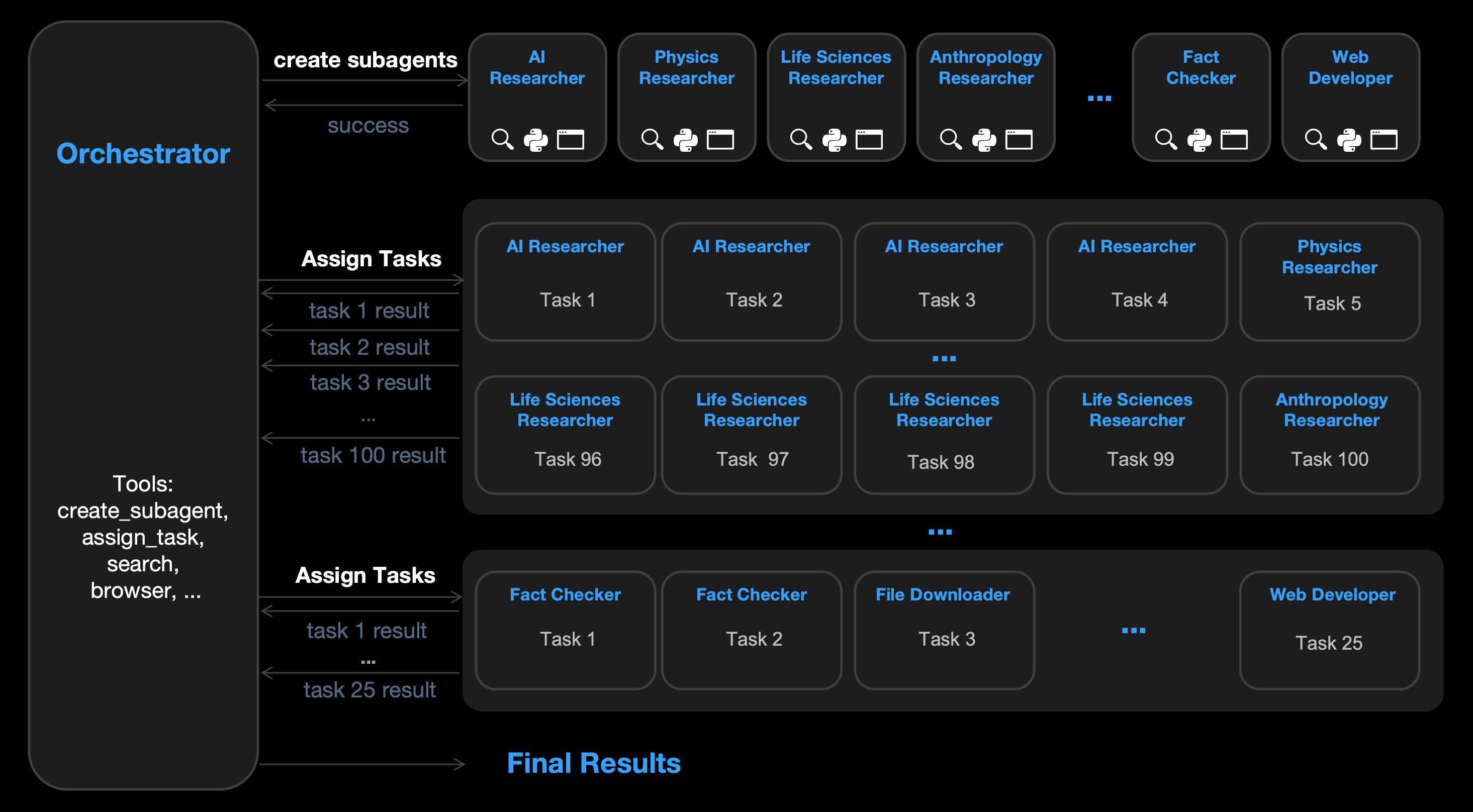
Kimi K2.5 thinks differently. It can break down complex tasks into dozens of sub-tasks. Then it spawns up to 100 specialized sub-agents. Each agent takes on a part. They work in parallel. They verify each other. The result is more precise than anything a single agent could deliver.
Example: You want to analyze 50 competitor websites. In the past: You write a massive prompt and hope for the best. Today with K2.5: The model distributes the work automatically. One agent crawls, one extracts data, one synthesizes. Everything in parallel. Everything coordinated.
Native Multimodality
No adapter hack. Vision and text were trained together from the start. The model does not understand images as an add-on, but as first-class input.
256K Context Window
Enough for entire codebases, long documents, or multiple research papers simultaneously. In Thinking Mode, even up to 96K tokens for internal reasoning.
INT4 Quantization
Twice as fast as comparable models. Without loss of quality. Moonshot used quantization-aware training, not post-hoc compression.
Two Modes
Instant Mode for fast responses (Temperature 0.6). Thinking Mode for deep reasoning processes (Temperature 1.0). You choose what you need.
Visual Coding: Screenshots Become Apps
This is where Kimi K2.5 saves developers real time. You show the model a UI design. It generates the code. HTML, React, Tailwind. Functional. Responsive.
Other models hallucinate with complex layouts. K2.5 understands spatial relationships. It recognizes buttons, grids, hierarchies. And it writes code that actually looks like the image.
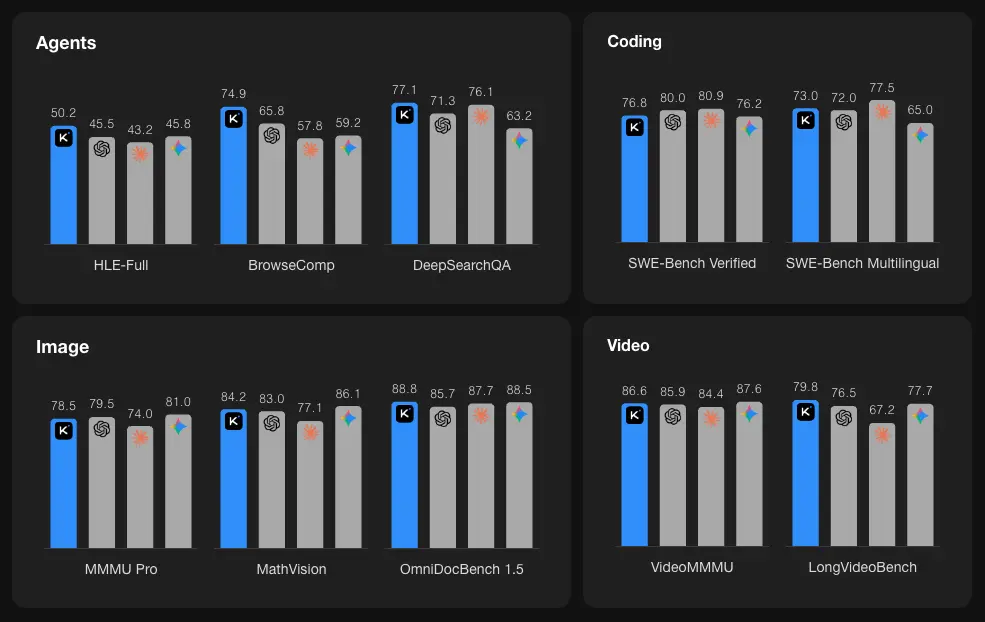
On SWE-Bench Verified, K2.5 scores 76.8 percent. Those are real engineering tasks. Not synthetic benchmarks. Real-world code problems in large repositories.
Benchmarks: Numbers That Count
Nobody cares about marketing speak. Here are the facts:
50.2% on Humanity's Last Exam (HLE) with tools. That is state-of-the-art for open-source models. HLE tests expert knowledge across 100+ subject areas.
96.1% on AIME 2025. A math competition for high school whizzes. K2.5 uses its internal Python environment to verify solutions.
78.5% MMMU-Pro, 90.1% MathVista. Visual reasoning tasks. The model doesn't just understand images, it can reason about them.
Use Case: UI Development
Designers deliver Figma files. K2.5 generates production-ready code. Frontend teams iterate faster and focus on logic rather than layout.
Use Case: Research
One agent collects papers. One extracts findings. One checks logic. The swarm synthesizes a report. No manual intermediate steps.
Use Case: Document OCR
Complex PDFs with tables, graphics, multiple languages. K2.5 parses everything natively. No separate OCR tool needed.
Use Case: Coding Agents
Debugging across multiple files. Refactoring entire codebases. Writing unit tests. K2.5 coordinates sub-agents for every step.
Conclusion: Coordination Beats Raw Power
Kimi K2.5 shows where the journey is heading. Not larger models. Smarter coordination.