AI Architecture
The Human AI Brain
Why language models are just the beginning and what happens when we build AI like a brain. Published on 13 October 2024 • AI translated
LLMs are often called "dumb" because they merely predict words. That is true. And it falls short. It only gets exciting when we place them as a building block into a system that thinks, learns, and makes decisions like a brain.
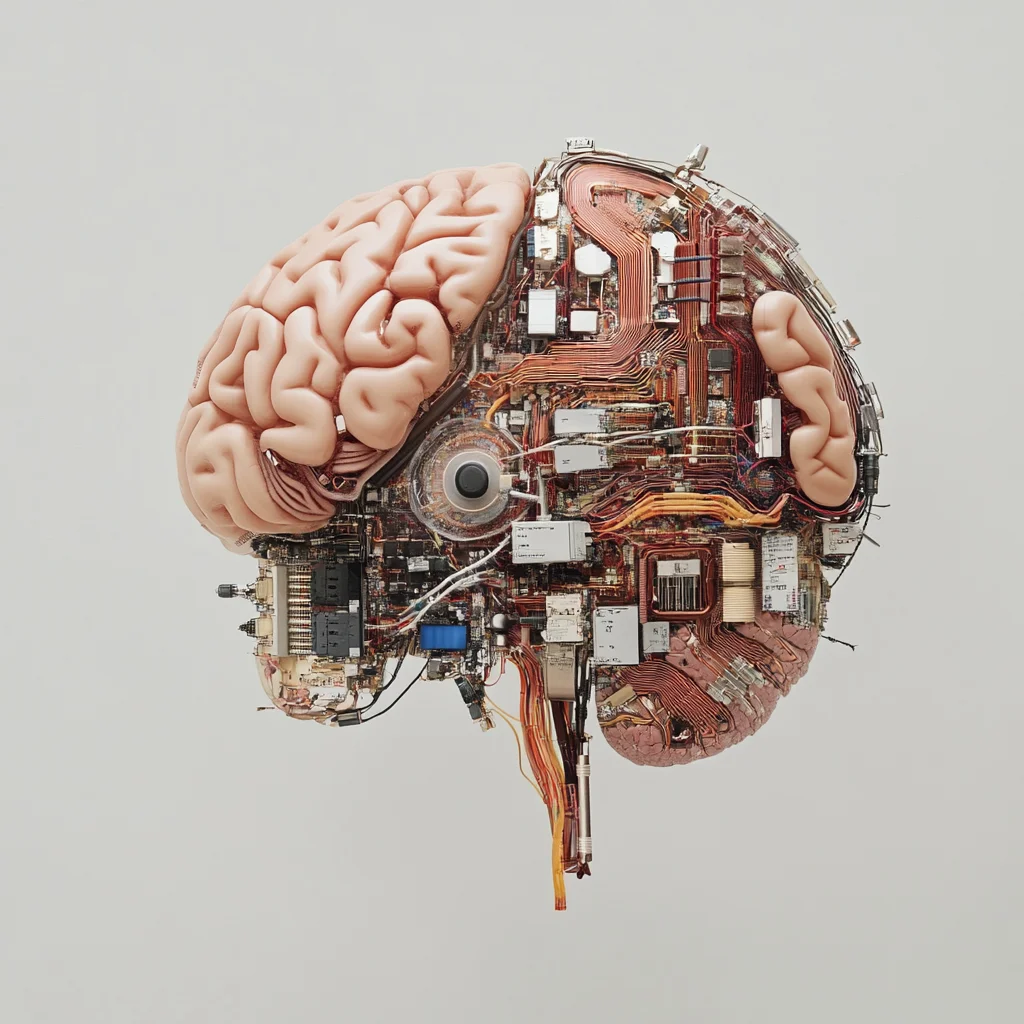 At the zero-shot level, many large language models indeed appear like elegant autocomplete machines. They react to input and deliver output without any visible working memory, plan, or goal. The problem is not the model. The problem is the expectation that a single model should cover the entirety of "thinking." My thesis is simple: we need an AI architecture that is more reminiscent of a brain than of a single text generator.
According to OpenAI, newer models such as GPT-o1, previously discussed under the project name "Strawberry," represent a step in this direction. The crucial factor is not just the quality of the answers, but the internal reasoning process prior to the response. OpenAI describes this as a hidden "chain of thought"—an internal reasoning path that does not simply guess the next word. This is not proof of consciousness. However, it is an indication of how systems can be built to reach conclusions in a more structured manner.
At the zero-shot level, many large language models indeed appear like elegant autocomplete machines. They react to input and deliver output without any visible working memory, plan, or goal. The problem is not the model. The problem is the expectation that a single model should cover the entirety of "thinking." My thesis is simple: we need an AI architecture that is more reminiscent of a brain than of a single text generator.
According to OpenAI, newer models such as GPT-o1, previously discussed under the project name "Strawberry," represent a step in this direction. The crucial factor is not just the quality of the answers, but the internal reasoning process prior to the response. OpenAI describes this as a hidden "chain of thought"—an internal reasoning path that does not simply guess the next word. This is not proof of consciousness. However, it is an indication of how systems can be built to reach conclusions in a more structured manner.
When you take the human brain as a blueprint, one thing stands out: it is not a monolith, but a network of specialized areas. Language processing, decision-making, and memory are not randomly distributed, but organized through a division of labor. It is precisely this modularity that makes it interesting for AI. Not because biology is romantic, but because it is efficient.
Modular Architecture Instead of a Monolithic Model
An AI system becomes stronger when language, memory, and action planning are built as separate components.
LLMs as the Language Center
Models such as GPT-o1 can serve as the linguistic core, provided they are embedded in a system with goals and feedback.
Short-Term and Long-Term Memory
Just like in humans, it requires fast, ephemeral contexts and robust stores that remain stable over time.
External Knowledge Access
Browsing and APIs are the equivalent of reading and observing. Without these channels, knowledge ages too quickly.
ToT and Agents as Modes of Thinking and Working
Tree of Thought and specialized agents help evaluate options and work through tasks by agenda rather than merely generating text.
Under this logic, LLMs are the language center, not the whole brain. Their strength lies in nuance, context, and formulation—especially when a model first evaluates internally and then responds. OpenAI describes GPT-o1 as a model capable of competing with experts in areas such as mathematics, programming, and physics. Whether this holds true in every setting depends on the problem and the context. What is clear, however, is that "thinking before answering" enables a different level of quality.
The next lever is memory. Humans intuitively distinguish between what is only needed briefly and what is relevant in the long run. AI systems benefit from working similarly—possessing a fast short-term memory for immediate contexts and a long-term store for persistent facts, preferences, and experiences. In your example, GPT-o1 is described as a model with improved memory management and decision-making processes. That feeds directly into better, more context-aware responses.
Then comes the part that many systems still underestimate: external knowledge access. Humans do not remain smart simply because they learned something once, but because they continually reload, verify, and correct. When AI can access real-time data via browsers or APIs, it becomes less speculative and more verifiable. In your outline, that is precisely the idea: AI should not merely process, but continuously expand its understanding.
For more complex tasks, better thinking frameworks are also required. Tree of Thought (ToT) compels a system to evaluate multiple pathways instead of immediately blurting out the first available answer. Agentic systems go a step further and divide the work, similar to brain regions or a well-managed team. One agent gathers knowledge, one plans, one assesses risks, and one writes cleanly. Together, an output emerges that comes closer to human problem-solving.
Where This Leads
The direction is clear: away from the single language model as an all-rounder, toward brain-inspired systems with modules, memory, tool access, and explicit thinking and working processes. GPT-o1 serves in your text as a strong example of the language center that reasons in a more structured manner internally, thereby unlocking new realms of performance. Yet the real opportunity lies in the architecture around it. That is where it is decided whether AI merely writes pretty sentences, or whether it truly helps to understand the world better.