Deepseek V4: Why China is just tipping the AI playing field
An open-source model at frontier level, at a fraction of the price. And that will be costly for the US. Published on 28 April 2026 • AI translated
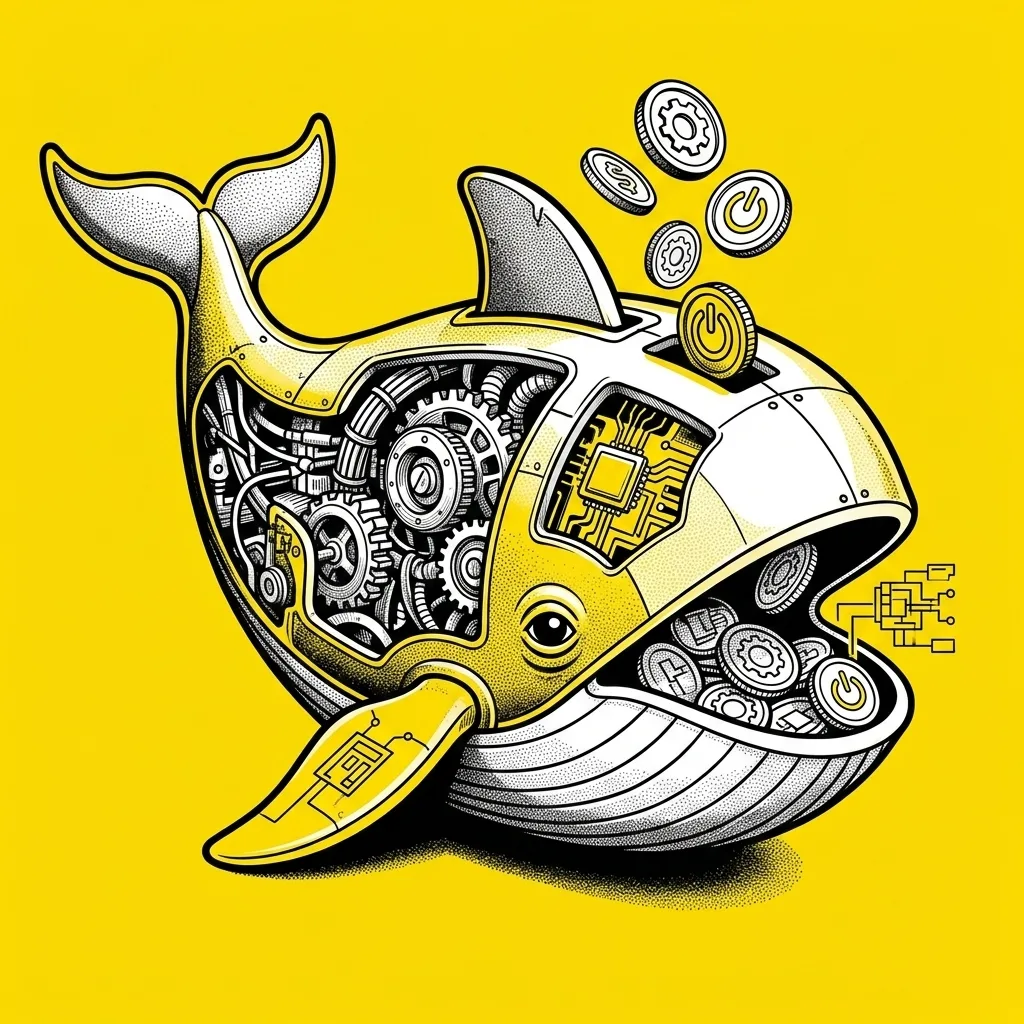
The US has the best chips. The most capital. The strongest labs. Yet China delivers a frontier model that keeps pace. Completely open, completely open-source, at a fraction of the cost. And doing so with throttled Nvidia GPUs. That shouldn't actually be possible.
Who is Deepseek? Around 18 months ago, R1 arrived. The first open thinking model that showed that frontier intelligence is not a monopoly of closed US labs. The market reacted. Stock prices slumped briefly because the question suddenly arose whether Nvidia GPUs were really worth their money. The answer came with Jevons paradox: when something becomes cheaper, you consume more of it. Demand exploded.
Now V4 is here. Along with an honest, detailed whitepaper. More transparent than anything coming out of closed US labs.
1. V4 Pro
1.6 trillion total parameters, 49 billion active. Mixture of Experts. One million tokens context. Frontier-level.
2. V4 Flash
284 billion parameters, 13 billion active. Smaller, faster, cheaper. The workhorse.
3. Training
Both models were trained on around 33 trillion tokens. Strong agentic capabilities, world knowledge, top reasoning.
4. Benchmarks
Just behind Opus 4.7 and GPT 5.5 on MMLU Pro, GPQA Diamond, SWE-Bench. Slightly behind, but only slightly.
And that is precisely the real story. Most use cases do not need absolute frontier intelligence. When a model is almost just as good, but massively cheaper, the math for businesses becomes brutally simple.
Are export controls working? Yes and no. Yes, because China simply has less compute. No, because Chinese labs compensate by delivering on the algorithm side. They train and infer more efficiently. With throttled GPUs, they build frontier models. Jensen Huang therefore argues in favour of selling top GPUs to China. The logic: China will build its own chips anyway, so they should at least build on top of US technology. The same argument applies in reverse, and that is precisely the problem.
Anthropic recently documented distillation attacks. Chinese labs are said to feed Claude and ChatGPT with questions, scrape the answers, and train their own models. The US government now publicly confirms: yes, this is happening. But the report also shows: Deepseek conducted just 150,000 exchanges. Moonshot had 3.4 million, MiniMax 13 million. 150,000 is not enough to explain V4. Add to that the open whitepaper. The narrative of theft as the sole explanation does not hold up.
The whitepaper also states: Deepseek is so compute-constrained that they cannot even serve V4 Pro optimally. The price is higher than it needs to be. Following the rollout of the 950 supernodes in the second half of the year, it will drop significantly. Meaning: what is already cheap today will become even cheaper.
| Model | Intelligence | Price per million output tokens |
| GPT 5.5 | Very high | Around 30 USD |
| Opus 4.7 | Very high | Similarly high |
| Deepseek V4 Pro | Just below | A fraction of that |
| Deepseek V4 Flash | Solid | Cents per million tokens |
Imagine you are the CEO of a company in the US or Europe. You compare Opus 4.7, GPT 5.5, and Deepseek V4. You are not conducting frontier research. You are not solving the world's most difficult coding problems. You run a business. Your model covers your use cases. The price is a fraction. It is open source, so you can fine-tune, self-host, and customise. The decision makes itself.
And this is precisely where it gets tricky for the US. If more and more Western companies build on Chinese open-source infrastructure, a strategic dependency risk emerges. If Chinese labs alter the architecture or cut off access, entire tech stacks grind to a halt. In addition, there is the economic dimension: trillions are flowing into US AI infrastructure. The return must come. If it doesn't, because the world switches to Chinese models, the US economy has a problem.
And then there is the cultural level. Social media originated in the US and shaped narratives worldwide. Now that could potentially reverse. If Western products run on models trained under Chinese guardrails, a different actor determines what can and cannot be said. That is not fearmongering; it is a real issue.
What the US must do now
Two things. First: lean much more heavily into open source. Major US labs, with the exception of smaller Google models, are leaving this field bare. A serious, open counterpart to V4 is missing. Second: efficiency. Even if models remain closed source, OpenAI and Anthropic must quickly become cheaper. Otherwise, the calculation will turn out the same for every CEO worldwide. Deepseek is doing almost everything right at the moment. If the West does not follow suit, China will write the next chapter of the AI economy.